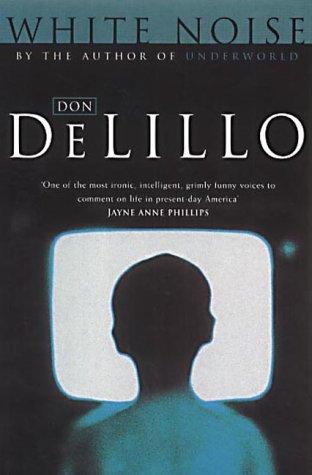
[Cue Rod Serling]. Meet: Jack Gladney. Age: No longer young. Jack is a professor at a university, call it "the college-on-the-hill." He lives in a "town of dry cleaning shops and opticians. Photos of looming Victorian homes decorate the windows of real estate firms. These pictures have not changed in years . The homes are sold or gone or stand in other towns in other states. This is a town of tag sales and yard sales, the failed possessions arrayed in driveways and tended by kids." He lives with his loving wife Babette and four children and chairs the Department of Hitler Studies. To others, Jack appears reliable, intelligent, focused, ready to enter his old age with the dignity and sense of fulfillment that should accompany him into these later years. [Screen shows a picture of a black-robed department head with dark glasses stalking across a college campus]. Yet, under the surface, Jack hides a terrible secret, a secret that's been festering under the skin, a kind of undiscovered cancer, for years, a secret that will soon come to light. For, unbeknownst to him, Jack Gladney is about to enter...
THE TWILIGHT ZONE.
Given the novel's focus on the media, and (black-and-white) television is particular, the Twilight Zone reference seems specifically apt. The entire first half of this novel, called "Waves and Radiation," should be narrated by Rod Serling. "A town of tag sales and yard sales, the failed possessions arrayed in driveways and tended by kids"? As these sorts of descriptions of this tiny college town (if you've ever been to Shippensburg, Pennsylvania, use that as your mental setting) build up, they all start to lead you to an inevitable conclusion: Something horrible is going to happen here. Soon. It's the equivalent of the sunny music and cheerful suburban faces of the fifties at the beginning of a Twilight Zone episode. Everyday American utopia tranformed, revealed, corrupted by the knowledge that it will soon to shattered by aliens, Soviet nuke attacks, time warps. In this case, the disruptive force is an "airborne toxic event," a chemical spill that causes the town to evacuate, to bunk down in an abandoned boy scout camp, trying to outrun a cloud. Pittsburg, Pennsylvania, AKA "Steel City," is never named and simply called "Iron City." Hmmm...an "airborne event" in a Pennsylvania town causes a mass evacuation. The details differ somewhat, but this novel is basically a version of the Three Mile Island nuclear near-disaster, a relatively current event when the book was released.
Like The Twilight Zone, the milieu of this book is, unfortunately, dated. When this novel debuted in the early eighties, I'm sure the kids were, as the jacket describes them, "ultramodern," but it's laughable to apply that word today to a generation that didn't yet know the World Wide Web, cell phones, or iPods. Jack's friend Murray, a visiting lecturer from New York with the typical city dweller's romanticism about small towns, is, prophetically, obsessed by the "psychic information" that comes from TV (if you're rolling your eyes and thinking words like "artsy-fartsy"--RUN!). Although his philosophical meanderings about the nature of television still apply, they've lost some of their poignancy over the years.
I was, however, stunned by Don's ability to make you physically EXPERIENCE words. The complex, vague sentences take some work, but when you finally get it, you're imbued with a extremely specific flavor of feeling. It's not just shocked, angry, sad, elated here. It's "that-feeling-you-get-when-the-sun-starts-to-go-down-in-August-on-a-partly-sunny-evening-after-dinner." DeLillo doesn't write at all; he CONSTRUCTS. "I was beyond the traffic noise," Jack narrates as he stands in an old graveyard, "the intermittent stir of factories across the river. So at least in this they'd been correct, placing the graveyard here, a silence that had stood its ground. The air had a bite. I breathed deeply, remained in one spot, waiting to feel the peace that is supposed to descend upon the dead, waiting to see the light that hangs above the fields of the landscapist's lament." A strange kind of beauty.
By the end, I wanted to lay out the entire novel, all of the sentences, paragraphs, emotions, descriptions, events, and characters, so I could observe its structure in its entirety. It seemed to follow some engineering blueprint, some architect's master plan that, like the "starkly modern chapel" on Jack's college, can't possibly be appreciated with just one look at the resulting building. There are ornate niches here, a little hidden design over there. The plot is deceptively simple, but on almost every page there seems to be a sign post, some crossword clue that will make up the entire puzzle. The modern supermarket in the town, with "all the colors of the spectrum," serves as a sort of Portrait of Modern America, and when it starts to decay, gets rearranged, begins confusing people, well, then America is decaying, rearranging and getting pretty confusing, too. Jack teaches Hitler studies and his son's name is Heinrich, but he can't speak German. Everything has a "point": "That is the point of Babette." Everything is "obvious." You could probably write out every sentence separately on a piece of paper and then draw lines connecting them, like a literary fractal.
And above all the layers of hidden meaning, the gothic windows on this structure: Death and Television. "Who will die first?" Jack asks as he watches Babette exercise on the high school stadium bleachers. Once Jack is exposed to the toxic cloud, his horrible secret emerges. Jack is terrified of Death. He must grapple with it just as modern society must grapple with the new, pervasive media. He confronts Death in the image of television, in the image of all the "signals" bombarding the "modern" mind. Little did the Eighties know. I found myself wishing White Noise was written in 2008. When the kids watch television, I wished they were surfing the Web, playing endless video games, posting secret videos on YouTube. I longed for a narrative this poignant about the Internet Age. Falling Man was good, but it was too specific. I had to be content with comparison: When Jack observes the constant "evacuation drills" that obsess the town (and in which his daughter participates) after the toxic airborne event, I just put it in the context of the constant anti-terror drills after 9/11. Maybe the novel is best appreciated in its natural environment of the Eighties, but with the American Public's mixed reaction to the media ("it's evil" vs. "give me more Lindsay Lohan and Gaza bus explosions!") still so very relevant, it was hard to confine it to history. It still straddles a strange middle ground behind "so outdated it's no longer really relevant," and "oh, my gosh, that's still true!" Basically, read quickly. The relevancy is melting away faster than the ice caps.
This is what happens when mystical meets practical. In other words, White Noise is what results when sensitive men write novels. A rare breed indeed. In the Post-9/11 world (take a minute to rinse the sour taste of that phrase out of your mouth), when a growing number of people (let's face it, mostly rural people) are focused on hoarding peanut butter and buying nuclear radiation detectors to "survive" some foreseen disaster, the novel is a confirmation of everyone's worst fears, a tale of what could be, a sort of Disaster Porn. The prose, however, is truly fantastic. As evidenced by the seven shelves of "fiction" on display at my local bookstore, pretty much anyone can put together a plot, and a large number of them can sleep their way into the door of a publishing company, but only a few can actually WRITE like Don DeLillo. This is not a novel you read on an overnight flight. Be prepared to actually engage. And yes, that means THINK.
So carve out some time and clear out the cobwebs. It's really a narrative that will haunt you for days, weeks, and maybe even years.
HIGHLY RECOMMENDED
THE TWILIGHT ZONE.
Given the novel's focus on the media, and (black-and-white) television is particular, the Twilight Zone reference seems specifically apt. The entire first half of this novel, called "Waves and Radiation," should be narrated by Rod Serling. "A town of tag sales and yard sales, the failed possessions arrayed in driveways and tended by kids"? As these sorts of descriptions of this tiny college town (if you've ever been to Shippensburg, Pennsylvania, use that as your mental setting) build up, they all start to lead you to an inevitable conclusion: Something horrible is going to happen here. Soon. It's the equivalent of the sunny music and cheerful suburban faces of the fifties at the beginning of a Twilight Zone episode. Everyday American utopia tranformed, revealed, corrupted by the knowledge that it will soon to shattered by aliens, Soviet nuke attacks, time warps. In this case, the disruptive force is an "airborne toxic event," a chemical spill that causes the town to evacuate, to bunk down in an abandoned boy scout camp, trying to outrun a cloud. Pittsburg, Pennsylvania, AKA "Steel City," is never named and simply called "Iron City." Hmmm...an "airborne event" in a Pennsylvania town causes a mass evacuation. The details differ somewhat, but this novel is basically a version of the Three Mile Island nuclear near-disaster, a relatively current event when the book was released.
Like The Twilight Zone, the milieu of this book is, unfortunately, dated. When this novel debuted in the early eighties, I'm sure the kids were, as the jacket describes them, "ultramodern," but it's laughable to apply that word today to a generation that didn't yet know the World Wide Web, cell phones, or iPods. Jack's friend Murray, a visiting lecturer from New York with the typical city dweller's romanticism about small towns, is, prophetically, obsessed by the "psychic information" that comes from TV (if you're rolling your eyes and thinking words like "artsy-fartsy"--RUN!). Although his philosophical meanderings about the nature of television still apply, they've lost some of their poignancy over the years.
I was, however, stunned by Don's ability to make you physically EXPERIENCE words. The complex, vague sentences take some work, but when you finally get it, you're imbued with a extremely specific flavor of feeling. It's not just shocked, angry, sad, elated here. It's "that-feeling-you-get-when-the-sun-starts-to-go-down-in-August-on-a-partly-sunny-evening-after-dinner." DeLillo doesn't write at all; he CONSTRUCTS. "I was beyond the traffic noise," Jack narrates as he stands in an old graveyard, "the intermittent stir of factories across the river. So at least in this they'd been correct, placing the graveyard here, a silence that had stood its ground. The air had a bite. I breathed deeply, remained in one spot, waiting to feel the peace that is supposed to descend upon the dead, waiting to see the light that hangs above the fields of the landscapist's lament." A strange kind of beauty.
By the end, I wanted to lay out the entire novel, all of the sentences, paragraphs, emotions, descriptions, events, and characters, so I could observe its structure in its entirety. It seemed to follow some engineering blueprint, some architect's master plan that, like the "starkly modern chapel" on Jack's college, can't possibly be appreciated with just one look at the resulting building. There are ornate niches here, a little hidden design over there. The plot is deceptively simple, but on almost every page there seems to be a sign post, some crossword clue that will make up the entire puzzle. The modern supermarket in the town, with "all the colors of the spectrum," serves as a sort of Portrait of Modern America, and when it starts to decay, gets rearranged, begins confusing people, well, then America is decaying, rearranging and getting pretty confusing, too. Jack teaches Hitler studies and his son's name is Heinrich, but he can't speak German. Everything has a "point": "That is the point of Babette." Everything is "obvious." You could probably write out every sentence separately on a piece of paper and then draw lines connecting them, like a literary fractal.
And above all the layers of hidden meaning, the gothic windows on this structure: Death and Television. "Who will die first?" Jack asks as he watches Babette exercise on the high school stadium bleachers. Once Jack is exposed to the toxic cloud, his horrible secret emerges. Jack is terrified of Death. He must grapple with it just as modern society must grapple with the new, pervasive media. He confronts Death in the image of television, in the image of all the "signals" bombarding the "modern" mind. Little did the Eighties know. I found myself wishing White Noise was written in 2008. When the kids watch television, I wished they were surfing the Web, playing endless video games, posting secret videos on YouTube. I longed for a narrative this poignant about the Internet Age. Falling Man was good, but it was too specific. I had to be content with comparison: When Jack observes the constant "evacuation drills" that obsess the town (and in which his daughter participates) after the toxic airborne event, I just put it in the context of the constant anti-terror drills after 9/11. Maybe the novel is best appreciated in its natural environment of the Eighties, but with the American Public's mixed reaction to the media ("it's evil" vs. "give me more Lindsay Lohan and Gaza bus explosions!") still so very relevant, it was hard to confine it to history. It still straddles a strange middle ground behind "so outdated it's no longer really relevant," and "oh, my gosh, that's still true!" Basically, read quickly. The relevancy is melting away faster than the ice caps.
This is what happens when mystical meets practical. In other words, White Noise is what results when sensitive men write novels. A rare breed indeed. In the Post-9/11 world (take a minute to rinse the sour taste of that phrase out of your mouth), when a growing number of people (let's face it, mostly rural people) are focused on hoarding peanut butter and buying nuclear radiation detectors to "survive" some foreseen disaster, the novel is a confirmation of everyone's worst fears, a tale of what could be, a sort of Disaster Porn. The prose, however, is truly fantastic. As evidenced by the seven shelves of "fiction" on display at my local bookstore, pretty much anyone can put together a plot, and a large number of them can sleep their way into the door of a publishing company, but only a few can actually WRITE like Don DeLillo. This is not a novel you read on an overnight flight. Be prepared to actually engage. And yes, that means THINK.
So carve out some time and clear out the cobwebs. It's really a narrative that will haunt you for days, weeks, and maybe even years.
HIGHLY RECOMMENDED
*NOTE: In the news 10/12/08--Right from the book: Chemical Leak Forces Western Pennsylvania Residents to Flee


No comments:
Post a Comment