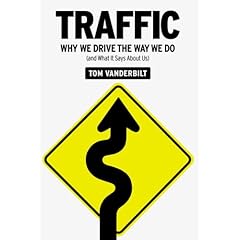
"You're a bad driver." In America, a nation built on Automobile Culture, it's hard to find a accusation that provokes more heated defenses that that one. The subtitle of this book is "Why We Drive the Way We Do (and What It Says About Us)," and, by the time Tom's through with you, he's hoping to convince you that it says a WHOLE lot about you--something I think many people suspect, which is why the issue can get thorny. "A messy desk means a messy mind" they used to say, prompting a new question: Does being a bad driver make you a bad person?
If the answer is yes, we apparently have a problem, because Tom throws a library's worth of data and anecdotes on you in a seeming attempt to prove that most Americans are, in fact, terrible drivers. We talk on our cell phones, read our papers, work on our laptops, drink our coffee, and fiddle with our MP3 players while navigating toll plazas. After a mere 30 seconds of waiting to make a left through traffic (after Tom's many subtle polemics about the problems of left turns, I started to wonder whether he was advocating an all-right-turn America), we get antsy and start to think about cutting in front of that tractor trailor coming at us at 70 mph.
That is, if we perceive it--it turns out we're terrible at judging distance and speed. Humans can only run, at most, 20 mph, so doing 60 mph in a careening deathmobile called a car isn't exactly recommended in our evolutionary instruction manual. We also tend to hit a lot of bicyclists. And little children. And "stationary objects." Believe it or not, "single-car" crashes (read: driver sees UFO while driving down I-80 and swerves off the road, striking a speed limit sign) are the most common type of accident. In other words, not only do we crash a lot, but we also have dorky crashes--forget Lethal Weapon. And, by the way, "studies" tend to show that people do "live as they drive," which promotes the policy of insurance companies looking at credit scores when determining rates, on the basis that people who are riskier with credit will be riskier drivers. More on why you should probably be suspicious of these "studies" translating into policy later.
The information is packed tightly together: Tom brings in evolutionary biology, the dynamics of insect traffic management (ants are the undisputed kings), and neo-Freudian psychology to explain how and why we humans behave the way we do in traffic. Why do more roads create more traffic? Are divorcees more likely to have accidents? And, of coure, how in God's name does the city of Los Angeles manage its famously suicidal traffic situation? If you're a researcher, the notes are a real treasure trove of information; basically, the research has already been done for you, so find a new job. Tom interviews New York City traffic commissioners, Los Angeles ATSAC managers, and European traffic engineers, coming up with a wide range of opinions and statistics in nine medium-sized chapters. Much of it is fascinating: He introduces Hans Monderman, a European traffic engineer who advocates turning "village" roads into more pedestrian-friendly places (a nod to the "New Urbanism" movement).
Tom also presents a fairly convincing case for congestion pricing in America, although I still disagreed. He points out that "hotels charge more for in-season rooms, railways and airlines charge more for peak travel periods, and telephone companies charge more during the times when more people are likely to call--why should roads not cost more when more people want to use them?" As a capitalist, I was tempted to support this argument, except for one problem: Hotel rooms, airlines, and even long-distance telephone calling are luxuries; roads, at least in America, no longer are. Our infrastructure is built around them, and besides being wildly inefficient as anything controlled by the government would be, congestion pricing could also derail productivity. Still, the fact that he made me consider it is a considerable compliment to him.
Far into the grimy alleyways of this book, around page 253, Tom throws in a sentence that should be front and center, in the prologue: "statistics are one of the most dangerous things about traffic." The sentiment is taken out of context here--it's mentioned in relation to a discussion on rear-end crashes--but a book that relies as much on statistics as this should probably acknowledge it more openly. Unless your cynicism glands are malfunctioning, you'll probably start to tire of every sentence beginning with "studies have shown..." or "researchers in Sweden have found..." or "psychologists have discovered...". Maybe the studies are valid--after all, it did make intuitive sense that traffic fatalities tend to decrease as GDP per capita increases, and that roundabouts are actually safer than conventional intersections (because people are less certain of what to do, they tend to drive more cautiously). But after "studies" have "shown" that power lines cause cancer, BPA is the doomsday chemical for all human infants, and all white people are "racist," I was highly skeptical of these results on a scientific level. Although Tom provides an extradordinarily detailed bibliography explaining exactly where he got his information (papers with names like "The Perception and Cognition of Environmental Distance: Direct Sources of Information"), I started to suspect that he only questioned the "studies" that conflicted with his own personal opinions, which, to be fair, he valiently tried to keep out of the narrative. "Studies" bashing SUVs were prevalent, as were "psychological theories" about everything from BAC levels (they're not set low enough) to how drivers perceive bicyclists. I would caution the reader to be skeptical: Were these "studies" conducted fairly and without bias? Did they include stringent operational definitions of all involved concepts? Were they double-blind? Of course, it's impossible to wade through the astonishing amount of information Tom provides, both in the text and in the notes, so a general aura of suspicion should rule the day.
A couple of other problems: For math-a-phobics, the narrative sometimes tends to read like a physics book. He describes scenarios in specific velocity-speed terms that occasionally become a little heavy if you're expecting a quick read. If you're willing to follow it, the results can be worthwhile. Also, Tom goes a little easy on pedestrians, sometimes making them out to be helpless victims in a massive conspiracy of car drivers to flatten them in the nation's intersections. While, statistically, it may seem like drivers are trying to do just that, the fact remains that some pedestrians (e.g. the ones who walk against traffic signals, and the ones who do their makeup as they jaywalk across city streets) make their own beds. Cars have rights, too, Tom!
Still, don't let these things bother you too much: Just keep an open mind and you'll learn things you never suspected about all the hundreds of "sub-skills" you activate when making your (on average) 1.1 hours of commute per day. Tom's tone is conversational, and he tries to be nice when he suggests that you get a little more "feedback" on your driving before deciding you're a pro at it. And the environmental impact of cars? I couldn't have agreed more with Tom's sentiment in the epilogue: "It will be easier to remove the internal-combustion engine from the car than it will to remove the driver."
The real question is, of course, left open in the end: What will the future of transportation look like? The next few years should be interesting. For now, though, climb in the driver's seat at your own risk: It's a scary road out there.
RECOMMENDED