 I think it was the night that my roommate came home drunk and broke my fishbowl at three in the morning that I first seriously considered the sort of questions Rebekah asks in this book. I'll spare you the full story, but needless to say, it was a LONG night, one that required escorting my (angry) drunk roommate to the bathroom, cleaning up a fishbowl and pulling a fish from the jaws of death on my shag carpet, lining possible puke cans with plastic bags, and listening to a lot of incoherent ramblings, none of which she would remember in the morning, and all of which I would. Although not one to need a religious eight hours of sleep, I was exhausted after this all-nighter and, just as a side note, in great pain due to my own medical condition. Despite having done a fair amount of homework the night before, I had a full load of readings, tests, and group projects to manage for the next day, an agenda through which I would have to labor, like it or not.
As I tried to decide which side of my double vision was least blurry as I attempted to read my Philosophy assignment, I wondered what my professors were doing at that moment. There was an outside possiblity that they'd had an even worse night involving a drunk spouse, but most likely they were at home, preparing for their lectures and stimulating "discussions" (all college students know that "college discussion" is an oxymoron) that would go on in class the next day. In other words, I would walk in, having done the reading, give them the right answers, take notes studiously, and walk out, and my professors would have no clue about the drunkscapade that I was privy to only a few hours earlier. NO CLUE.
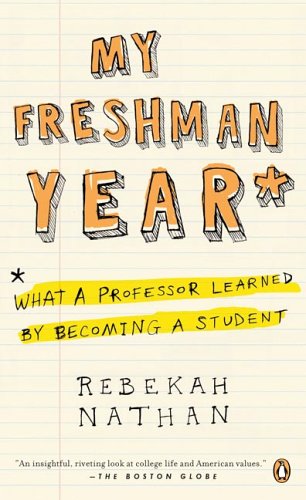
This generational and occupational gap is what motivated anthropology professor Cathy Small, AKA Rebekah Nathan, to do what, to her colleagues, was openly unthinkable: Go undercover as a student at her own university, albeit as an older "returning" student. She went through the ritual "summer of the envelopes," a tradition almost as static as freshman year itself, when each lucky student wheelbarrows in registration mail that demands decisions. She had to chose a meal plan and dorm living options (yup, she even lived in the dorms). She also had to attend what is almost definitely the most hellish part of the entire college experience: "Previews" and "Welcome Week" activities for incoming freshmen. If you've blocked it out of your mind, allow me to rekindle the reclaimed neurons: Bean bag games with complete (eighteen-year old) strangers, "name games" where everyone goes around the circle and says something about themselves ("uh, hi, I'm Jenny from Michigan, my major is elementary ed, and I like strawberry ice cream" x twenty), and "ice breaker" activites, which Cathy admits was the dominant type of activity through her entire first two weeks of classes. Cathy, clearly an extravert, seemed to borderline enjoy this medieval gamut, though, which slightly disappointed me.
Cathy presents her experiences in seven chapters, which are admittedly vague in particular details for the sake of privacy and ethics. In the dorms, however, she does immediately notice something old people always notice about young people today: We have a DAMN lot of STUFF. While Cathy has only some modest necessities with a few luxuries, she notices that her newfound peers have "joysticks, couches, mountain bikes, ski and sports equipment, guitars and keyboards, large and elaborate sound systems, multiple-layered electronics shelves holding TVs, VCRs, DVD players, refrigerators, tables, cabinets, floor and pole lamps, overstuffed throw pillows, as well as coffeemakers, slow cookers, and illegal sandwich grills." The Affluent Society indeed.
But it's more than that, Cathy notes, and she then proceeds to make an observation about her 1940s-built residence hall that I noticed during my own first month of freshman year: Almost none of it is used. Her hall has a spacious lobby with a TV and lots of chairs clustered around, an activity room and communal kitchen, and lounges on each floor with a TV, VCR, and tables where people can eat and socialize together. All of these loftily-designed community "togetherness" spaces are ghost towns most of the time. The place is a black hole of wasted space. During Super Bowl weekend, Cathy ventures into the lobby, where, advertisements plastered on every bulletin board squawk, there will be a get-together to watch the game on the communal TV. Seven people show up. As Cathy walks back to her room, she can hear the same game blaring from every room in the hall. Everyone is watching the game together, all right, but in their own rooms, with their own TVs, and with popcorn popped in their own microwaves. Cathy withholds judgment, but the implication is clear: The Affluent Society has lead to The Alientated Society.
This leads Cathy to an anthropologist's watering hole: the subjects of "community" and "diversity." Before personal computers and televisions were the common fare of every college student, "community" had at least a dab of self-interest. If you wanted to watch the Super Bowl, or type up a sociology report, or grill up your own sandwich, you were pretty much forced to use community facilities (I'll avoid the word "communal" here for its association with things like the Cultural Revolution), and as long as you have to be around other people, you might as well get to know them. Now, of course, five families in Nigeria could live off all the food students keep in their rooms, and dorms come with internet jacks in every corner. This certainly discourages community-by-self-interest and, for better and for worse, there's not much more than self-interest to create community on a college campus in the United States. "Community" may be a popular buzzword for administrators but, as Cathy notes, "requiring common experiences is vastly unpopular." And, as with other things, anything not required is quickly swept under the rug, mostly out of necessity but also out of a sense of "individuality" inherent in American culture, a sense of "don't tell me what to do." International students Cathy interviews observe this trend as well.
"Choice" runs heavily in American culture, and while students may have fifty choices when they go to an electronics store to buy their new combination TV-DVD, they have fifty THOUSAND choices when it comes to structuring their own schedules. With all the variables involved--course, time, and major--with scheduling classes alone, there's a minimal chance that students at a state university (where Cathy teaches) will ever even run into each other, never mind form "community" bonds. And that's not even including off-campus jobs (which an increasing number of students have) and clubs and activities. As Cathy shows using some activity journals collected secretly (so as not to blow her cover) from four students in her hall, almost all their schedules are packed. But that's not all. She discovers that these students, like many she talks to, have solved the problem of the missing "campus community" by constructing their own tiny "communities" of a few close friends that they interact with almost exclusively. And--SURPRISE!--these networks tend to consist of people within their own ethnic, religious, and gender groups. Whites with whites, minorities with minorities, Christians with Christians, Muslims with Muslims--these are all strong association groups.
I'm sure Cathy's right--this DOES affect "diversity" on campus--but in this part she's probably the most judgmental, and her political colors start to show (guess what side of the aisle she's on?). As Cathy (reluctantly) whines about Generation Y's "blindness about racism" and "sexism," she reveals herself as a bitter Baby Boomer still aching to fight the battles of the Sixites. Take it all with a grain of salt.

Somewhere between setting up a dorm room, going to ice cream socials, rushing a sorority, working at a bar, and reconfiguring a laptop, students eventually have to swat at a pesky little bug called CLASSES. As a professor, you could tell that the biggest revelation to Cathy was just how little academics figure into what students affectionately call "the college experience." One of Cathy's volunteer projects in her dorm is to maintain little signs posted in the stall doors of the womens' bathroom, where quirky, sometimes funny anonymous questions are posed and anonymous answers given. When Cathy posits some all-in-fun questions of her own on these sheets, she finds that "very few students ranked class activites as constituting more than 50 percent of what they learned in college," a statistic with which most college students would readily agree. So why go to college? Some responses: "Who wants to be in the real world anyway?"; "College is too fun. Granted classes get in the way a bit but it's all worth the experience! I'm having a blast."
Academics do figure in somewhat, though. Although Cathy mentions that Generation Y students are very career-oriented and occasionally manipulative to achieve their own ends (an observation she isn't the first to make), she also notes that there are certain "classroom conventions" that students follow, a general attitude that she quotes fellow researcher Michael Moffatt as calling "Undergraduate Cynical." And it's true. VERY, very true. Doing well is fine, even admirable, Cathy notes, as it will get you the "good job" that the modern college student desperately, desperately wants (their parents probably won't keep buying them cell phones and TVs once they're off the "dependent" list on the tax forms), but you'd BETTER do it quietly. And for each "A" you get, you owe your fellow students some under-the-table insults about the professor, the class, or the university system in general. "Sure, I got an 'A,' but only because I practically sucked his dick during his office hours" or "Man, that class is so fucking easy, I practically slept through it and still got an 'A.'" It's not the best students, Cathy notes, but the most engaged discussion leaders who are the outcasts.
When the dust settles from this experience, Cathy admirably decides to restructure her own Intro to Anthropology class around some of the things she observed. Generation Y doesn't do "time management," they do "college managment," and that includes skimming of whatever work isn't absolutely necessary in order to accomodate packed schedules. Cathy decides to severely restrict her required reading to only what she really wants her students to know, and to design required, graded activites around them. She also realizes that scheduling is a matter of skill and luck, and if the scheduling gods aren't smiling on you this semester, you'll probably end up having five minutes to walk from one end of the campus to the other. With this in mind, Cathy gives her students some leeway about tardiness.
All in all, Cathy stresses that the number one lesson she learned from her experience was "compassion" for her students and all the hurdles they have to jump--social, economic, and academic--to achieve their dreams of a good education and a great job. Her willingness to study this world with the eye of an anthropologist is admirable. Maybe if students stood in their professors' shoes (especially during those silent "discussions"), they may have a little more compassion for them. That's an experiment I'd like to see.
HIGHLY RECOMMENDED.

