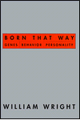
 With every new generation of college freshmen there comes the list of things they never saw. My freshman year, 2007, was one of those "landmark" years, underscoring just how far the world had come and just how many more grays you have in your hair: I wasn't born for the Cold War, that entire fifty years of history that provided the world with, among other things, Mutual Assured Destruction, Robert Ludlum novels, the Space Race, and Dr. Strangelove. As if that experiential omission weren't enough, the science-oriented know that I missed another war, too, one that arguably came closer to going "hot" than any conflict between Capitalism and Communism: The Nature-Vs.-Nurture War. The basis of the conflict revolved around whether behavior was caused by inborn characteristics or environmental influences, and it started the closest thing to a World War in the sciences, beginning in Psychology and Anthropology and eventually sucking in Biology and Genetics, too. Philosophy was involved, and at the end, even Political Science took its shot. And, in rigid similarity with the Cold War, everyone who witnessed it started writing about its history and implications before the ink dried on the peace treaty.
In the Nature-Nurture war, the peace treaty exists in a scientific atmosphere that still bubbles with academic reputations staked on one side or the other, and while most scientists conceded the inevitable--nature and nurture interact, and both have a place in understanding human behavior--old feuds still resurface and Nazi comparisons still abound. In this book, written around 1996, Wright attempts to chronicle the Nature-Nurture War with the perceived advantage of having "no published positions to defend, no scholarly reputation to protect, no academic toes to fear trampling." That said, it's clear from the get-go that Wright is far from unbiased. Academia's manaical devotion to "behaviorism," which attributed all human behavior to environmental conditions, drove Wright away from Psychology as an undergrad at Yale in the fifites. Human motivations may be many, but I had the feeling Wright's motivation in writing this book was only one: REVENGE. Unfortunately for a book rightfully trying to defend genetic causes behind behavior, that "there-will-be-blood" attitude compromises its credibility.
In eighteen medium-length chapters, Wright interviews prominent behavioral geneticists, scientists searching for the genetic basis to behavior in both humans and other animals. The major study he cites is a now-famous study at the Univeristy of Minnesota by Tom Bouchard of identical and fraternal twins "reared-apart," meaning adopted into different homes shortly after birth and not reunited until many years into adulthood. Since identical twins are nature's original clones, their genes are carbon copies, and this, combined with their different rearing environments, makes "teasing apart" environmental and genetic causes of personality and behavior a little easier. Unsurprisingly, the study found strong correlations in the reared-apart identicals as opposed to the fraternals, especially in the loaded area of IQ and and in extraversion/introversion. Despite different families and environments, most identical twins shared baseline character traits; if your identical twin, who you just met, is chatty, there's a good chance you are, too, for example. Observations of the twin sets involved also revealed Twilight Zone-ish eccentricities between the identicals who were meeting for the first time, including two identicals coming to their first meeting both wearing seven rings on seven fingers.
This study, along with many other twin studies and animal studies, prove beyond a reasonable doubt that there is some genetic components in behavior, something that, as Wright points out, breeders have known since the beginning of animal domestication when they bred cows for their docility and dogs to fetch hunted ducks (or squeaky toys). And, like it or not, Richard Dawkins and his atheistic gang are right when they say that humans are, at the base of it, just a peculiar sort of animal that happened to produce Confucius and Nietzsche.

The discovery of these innate chemical balances (or inbalances) contributing to everything from criminal tendencies to altruism crashed a decades-long party for socialists, progressive "activists," and other social reformers whose ideologies focused on what Wright calls "tabula rasa," or the idea of a the human as a blank slate. Wright quotes behaviorist John Watson's statement that, given any newborn, he could make him or her into whatever he wanted: good or evil, doctor or mechanic, murderer or do-gooder. Various genetic heritability studies proved this simplistic assumption entirely unfounded. The terms "activists" and "reformers" however, don't imply people who take challenges lying down, and the various "tabula rasa"-oriented groups didn't. Many, as Wright documents with rabid fury, still don't. He interviews one of them, Leon Kamin, who has publicly said IQ may have "zero heritability," disregarding mountains of evidence to the contrary.
In fact, throughout the years, the "radical environmentalists," a term social scientists use to refer to people who still believe genes play zero part in behavior, have used highly dubious and entirely irresponsible tactics against anyone who dared suggest a genetic basis for a trait. Sadly, Dodd's Corollary to Godwin's Law, stating that anyone who invokes Hitler or the Nazis in a debate has conceded the argument, isn't a law of nature, and some of the comparisons of behavioral geneticists with fascists stood without contest from level-headed observers. Fair questions were attacked rather than answered. For instance, why do only SOME inner-city blacks, in fact a very SMALL number, commit violent crimes despite their shared environment of racism and poverty? And, on the other hand, why do middle-class white kids like Ted Bundy, whose family ate dinner together each night in the petty-borgeois paradise of the suburbs, go on killing sprees? Wright is careful to point out that social factors are a huge part of behavior, just not the ONLY part, and this simple perspective was, for years, one of the most academically dangerous ones to hold in the United States.
Part of the modern stigma of this view stems from a notorious 1969 assertion by psychologist Arthur Jensen that the lower IQ scores consistently reported in black children relative to white children were due not to social factors but to genetic differences between blacks and whites. Although almost no behavioral geneticist agreed with him, the "Jensen furor," as Wright calls it, was the public face of behavioral genetics in the media for years after, and still is to an extent today, mining the territory of the field with accusations of racism and discriminatory social policy. The field is also laden with associations with the "eugenics" disaster of the early twentieth century, when otherwise-intelligent people started advocating sterilization for the mentally retarded and the criminally insane, among others.
Of course, modern behavioral geneticists don't support eugenics, and both the environmentally-oriented crowd and the genetically-oriented crowd (they're just "oriented" now--the war is over, but squabbles continue) include both political liberals and conservatives in their ranks, most united in believing that "knowledge is neutral," and that the public policy that may derive from that knowledge should not hinder the research into it. In other words, they all support academic freedom, in direct contest with campus radicals who believe they alone should decide what's researched. Wright describes instances of attempts at academic intimidation involving behavioral geneticist Dean Hamer, and, even more poignantly, describes witnessing protestors break into a behavioral genetics conference to shout down the speakers with blind exaltations of "genetics conference you can't hide, you're promoting genocide!" It's later revealed that sympathetic members among the conference-goers, the ones invited to provide their opposing views to the discourse, opened the doors for the protestors. This sort of perversion of civil disobedience, justified on so many campuses for the opposition of almost any cause deemed "dangerous," is among the most discouraging trends in American scholarship and debate today, and Wright's descriptions of it make a point far beyond the limited aspects of the behavioral genetics controversy.
Even with all this justifiable frustration, Wright goes a little far in his demonization of the opposition to genetic influences, sometimes treating them with the same snobbery he claims to abhor. The text sometimes reads like a Pat Robertson polemic, referring to behavioral geneticists as "the faithful" and describing the "conversions" of former environmentalists. Wright describes one author of a book about evolution as "a civilian Joan of Arc leading a handful of seasoned generals...[shattering] the fortress of behaviorism...."
Even worse are his characterizations of research by behavioral geneticists as "heroic," and descriptions of certain people as "carrying the torch" of the field through the days of environmentalism. At its worst, it was reminiscent of late-eighties Soviet propaganda, around the time Brezhnev caught his "cold," with all the empty references to "glorious heroes" of the "revolution." The rhetoric was distracting and unncessary. And for all the condemnation Wright lays on "the critics" about their "ad hominum" attacks, he takes a few swings that this method himself when he repeatedly chastizes respectable dissenters as practicing "dishonesty." He even goes so far as to call them "genophobes," invoking the specter of the label "homophobe" stuck to every unfortunate person guilty of suggesting gay marriage may have downsides. At the risk of sounding like an overplayed single off the Bush Derangement Syndrome soundtrack, the book was very us-versus-them. Read with skepticism.
One final aside before I come to the strangest chapter of the book. I'll just come out and say this: The writing was terrible. Wright frequently and confusingly changes topics right in the middle of a paragraph, and some of the arguments are so mired in grammatical convolution that they're harder to "tease out" than the very influences Wright is describing. Also, the tone of the text starts to fall into a low drone of blandly presented facts (when it's not exploding with near-religious passion). As an editor, I was constantly rewriting awkward sentences, and some I had to mentally restructure just to understand. In a world full of bad writing, it was a minor annoyance, but be prepared for it.
Finally, in the last chapter, called "Conclusions," Wright indulges in a science-writing tradition and plays around with some of the concepts he's covered, conjecturing about their possible meanings and uses. He correctly points out that public policy application of research is a "value question," not a scientific one, and should not inform scholarship. Instead, scientists should do the research first and then discuss and debate conclusions. With this disclaimer, I was willing to forgive the creepy suggestion that the government should intervene psychopharmaceutically with people at genetically "high risk" for crime. After all, this was only Wright's opinion, and he admitted it was up for debate. I could not forgive his extended metaphor about the link between genes and specific behaviors involving the abortion debate. He posits that "the pro-choicers' reasons--maternal rights, children's welfare, benefits to society--could be colliding with a gene in a portion of the population that says simply, 'killing fetuses is wrong.'" He then says that "if the antiabortionists...could see their stands as grounded in their biochemical makeup, rather than as moral convictions swathed in religious majesty, they might be more amenable to persuasion and compromise." This goes further than the obvious counterargument that the PRO-abortionists' stance may be gene-related, also. For someone who had an entire chapter entitled "Oh So Political Science," in which he argued that--you guessed it--science shouldn't be political, Wright engages in blatant hypocrisy here, certainly no better than behavioral genetics critic Richard Lewontin who says that "'Science is not and cannot be above "mere" politics.'" Wright exposes himself to the same political biases he accuses the critics of harboring. As it turns out, nobody's free of those very human motivations that inform so many of our decisions, including the writer a book about those very human motivations.
As a whole, the book was a good read, but the witch hunt mentality came very close to spoiling it. The shoddy writing didn't help, either. If you're a behavioral geneticist fresh off an attack from campus radicals or a radical environmentalist seeking a confrontation, you've found your holy grail. If, like me, you're looking for an unbiased account of the history and future of the Nature-Nurture War, you may have to search elsewhere.
VERY CAUTIOUSLY RECOMMENDED